History
A living monument
The Golden Mirror and the Silver Mirror
The quaint and often very expressive names are part of the magic of the old town. The Kattengat, or “Cat-hole”, is said to owe its name to a ditch so narrow that not even a cat could get through.
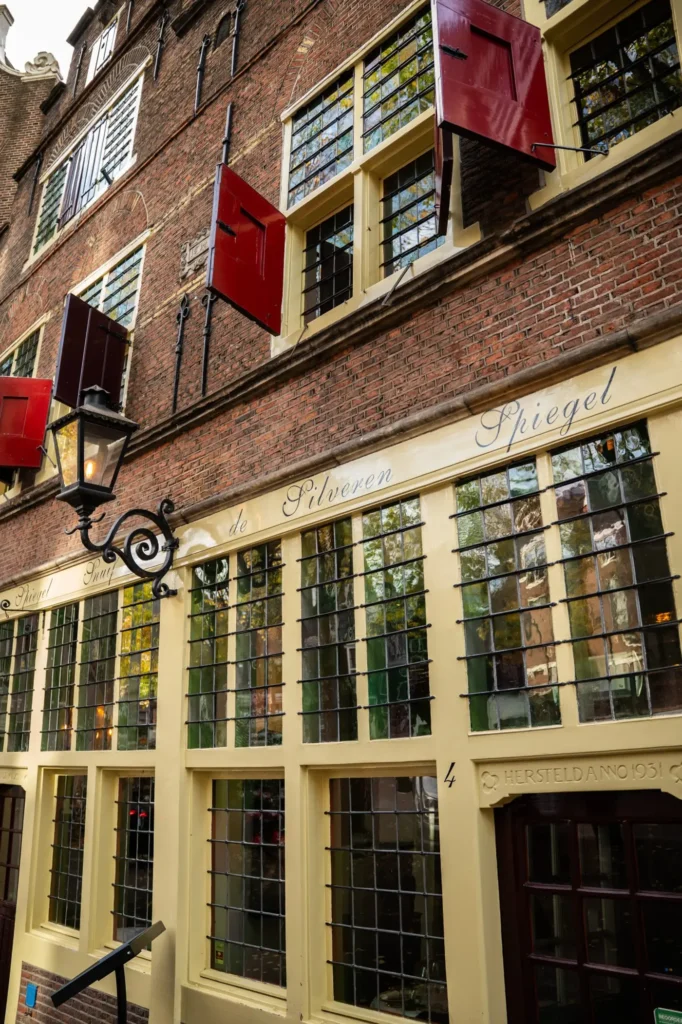
The twin step-gabled houses at Kattengat 4 and 6 were built in 1614. No. 6 was called De Goude Spiegel, the Golden Mirror, and No. 4 De Silveren Spiegel, the Silver Mirror.
The story in two chapters
Centuries held within these walls
Origins of the house
The Golden Mirror and the Silver Mirror
Strategic Importance of Waterways
The Nieuwezijds Voorburgwal and Nieuwezijds Achterburgwal were connected at the north end by the Kattengat and by a second narrowing at the south end where the Spui now meets the Singel. A similar situation obtained at the other side of the town where the Oudezijds Voorburgwal and the Oudezijds Achterburgwal were connected by ditches at Oudezijds Kolk — a kolk is a chamber of a sluice — at the north and Grimburgwal at the south end.
These narrow cuts were obviously of strategic importance in a town where water traffic played such a vital role.
Transformation of Kattengat
The Kattengat was filled in 1601, remaining a narrow alley until 1936. Since the inauguration of the Round Lutheran Church in 1671, its green brass dome has dominated the townscape with its colour and bulk. Many prominent citizens are buried in the church.
The twin step-gabled houses at 4 and 6 Kattengat were built in 1614 for the wealthy soap-boiler and town councillor Laurens Janz. Spieghel. No. 6 was called De Goude Spiegel, the Golden Mirror, and No. 4 De Silveren Spiegel, the Silver Mirror.
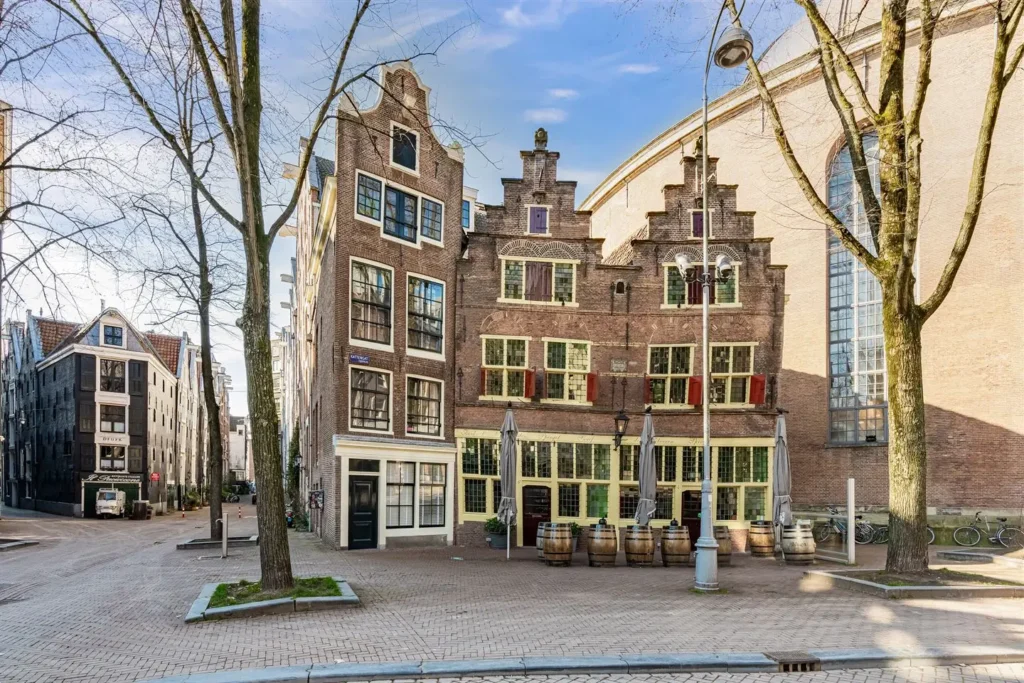
The twin houses at Kattengat, beside the Round Lutheran Church.
Architectural Details and Craftsmanship
The sandstone finials are formed by four mirrors each. A cartouche bears the date 1614. Spieghel seems to have relished the pun on his name, for he called his own residence De Drie Spiegels, the Three Mirrors. Like many early Amsterdam houses, both of these are supported by a wooden framework which has undergone some structural changes.
We may safely assume that the resilient quality of these wooden frameworks has saved many of our older houses from being shaken to ruin by the heavy axle-weight traffic of our day. Small as they are, these typically 17th-century houses embody the virtues of impeccable Amsterdam craftsmanship.
This is manifest in many details: the sturdy timbered basements, the small red bricks, solid wrought-iron cramps, sandstone bands and moldings, and the sandstone finials. Both houses originally had a front hall furnished with a spiral staircase. Since the property represented an investment, we can assume that the upper and lower floors were let as separate tenements, which is suggested by the position of the stairs immediately behind the front door.
Restoration by the Hendrick de Keyser Society
The Hendrick de Keyser Society, concerned with the preservation of art-historically important buildings, acquired both houses in 1926 and entrusted the restoration to A. A. Kok in 1932.
Four centuries of architecture, craftsmanship and human stories continue to shape the atmosphere today.
A remarkable wartime story
Restaurant de Silveren Spiegel during WWII
Above the Mirror, Kattengat, Amsterdam
Barend de Hond just stands there on the Jonas Daniël Meyer Square, hands in the air, in the middle of a razzia. He works for a demolition company and is a sturdy man, not unlike the dock workers who will go on strike later in protest of the mad persecution of the Jews. He knows a few words of German, enough to venture something. They are not going to get him; “Ich bin krank. Pein in me ruck!” he says in broken German — “I am ill, I have a backache.” It is his rescue, since the German allows him to leave.
It is spring 1941. The German occupation of the Netherlands has become systemized and very unpleasant.
01
Finding Refuge at de Silveren Spiegel
De Hond understands the situation and goes home, knowing that he, his wife and his son cannot stay there for much longer. For his demolition company he has regularly worked near the Kattengat and in the vicinity of the central station. He has often eaten a sandwich in the café beside the Lutheran church, de Silveren Spiegel. He knows the owner well: Wies Hofmann, an Austrian from Linz who thoroughly hates her compatriot Adolf Hitler. Perfect for a Jewish family in search of protection.
With his wife and only son, Ab, de Hond leaves their home in the Swammerdamstraat and moves to de Silveren Spiegel, where they will stay for the next four years. They hide under the ridge of the 17th-century roof.
02
Ingenious Hiding Places
As a demolisher, de Hond knows about all the nooks and crannies in the architecture of the Amsterdam Golden Age. He gets to work and creates an ingenious system of hiding places and panels to cover them up.
Hofmann’s café has been a popular haunt of German soldiers ever since the beginning of the occupation. Wies serves them schnapps with a broad German accent. She is quite fond of a drink herself and acts her role in a flamboyant fashion. She knows her German customers well, and none of these soldiers could ever suspect that Jews are hiding above their regular drinking hole. Oddly enough, their presence gives the hidden family an, albeit frail, sense of security.
Nevertheless, they have to take care at all times. Wies’s drinking habits are a risk. She often gets so plastered that she forgets to close the door after the guests leave. Then Barend has to sneak down quietly, lock the door and hoist his protector into bed.
03
Life in Hiding
The de Hond family do not remain with just the three of them. They are joined by more family members until sixteen of them hide under the roof. Sitting packed together like this is not very beneficial to family relations; they often argue and bicker, but always keep it indoors.
They kill time playing cards, doing veneer work and forging stamps with Indonesian ink for the resistance. They are not entirely cut off from the outside world, because they can listen to the BBC broadcasts on a little radio.
Audio archive
Oorlogspad — Radio
Listen to the original audio feature connected to this story.
04
Ab de Hond’s Perspective
From behind a small window with stained glass, Ab often looks into the street, where he can see the Germans marching in their black uniforms.
By day, when the café is closed and the shutters are closed, he can come down to do little jobs in the bar, such as removing fly droppings from the chandeliers. He also becomes quite skilled in installing barrels of beer. Across the street, on the Hekelveld, is the building of Het Volk, a pro-German newspaper. The janitor is called Landkroon. He has two daughters. They are good people and know about the people hiding in de Silveren Spiegel.
Sometimes Greetje Landkroon comes up to give Ab school lessons. He reads a lot: children’s books, comics and stories about the adventures of Rudolf the knight. It does impair his eyesight. He is not the kind of boy to keep a diary like Anne Frank is doing not too far away on the Prinsengracht. Ab will only hear of her after the war, when she has already been destroyed.
05
Tragic Losses and Close Calls
In their uncomfortable hiding place, the family bereaves one of its members: Judith Walvisch. She gets a neck infection and there is no medication. She dies of blood poisoning. In the middle of the night her body is dragged into the street and left there, on the cobbles of the Singel, in the pouring rain. The police officers who find her are surprised that the soles of her shoes are still dry.
Life in hiding continues with dread, sweat and constant alertness, all the time suppressing the fear of being caught. From time to time shouting could be heard from the Kattengat: “Barend de Hond!” It comes from Meerlant, the neighbour of de Silveren Spiegel, who runs a removal company and has two daughters who both date German soldiers. Ab is still convinced that it must have been Meerlant who betrayed the de Hond family.
The Sicherheitspolizei raids de Silveren Spiegel six times, but every time Wies Hofmann manages to press an alarm button under the bar. Every time, the Germans come no further than the attic, which they think to be the top space of the building. Then the stamping of boots, the harsh voices and the sound of gun straps disappear again.
Nevertheless, German soldiers keep frequenting the bar. In the cul-de-sac between de Silveren Spiegel and the Lutheran church, they sometimes park their army truck, loaded with goods, often including food such as canned sausages. Barend de Hond quietly sneaks down, climbs into the back of the car and steals the extra nourishment he can get. From the car he hears the Germans’ drunken brawls in the bar. Don’t ask how, but once he even manages to bring up half a horse.
It goes on and on. Days of duress cluster into weeks, months and years. The terrible wartime does not seem to end. The exhaustive wait aches. At the same time, life in hiding becomes a daily routine. It comes as a great relief when an alternative hiding place is found for some members of the family, after which only eight sit together in de Silveren Spiegel on the Kattengat until liberation. They were never put on transport; they never saw the camps. They have no stories of Westerbork, Auschwitz, Sobibor or Mauthausen.
5 May 1945
For the first time in four years, Ab steps outside and runs with all the energy freedom can give.
06
Liberation and Life After the War
When, on May 5th 1945, for the first time in four years Ab steps outside, he is ecstatic. In a phenomenal explosion of relief he starts running — away from the attic, away from the round tower of the church next to it, away from the Kattengat, towards the station, towards the water. He runs and runs and runs, with all the energy freedom can give, inhaling breath after breath of the free fresh air.
He stops at the Haarlemmerpoort and walks back to de Silveren Spiegel, a little more calmly, but still immensely happy, so very liberated from his lifesaving imprisonment above the beer draught.
When the Canadians arrive, he climbs on one of the amphibian cars. It is quite an experience to be cheered, and then he drives together with those impressive men straight into the water of the IJ. Ab does not fail to tell about the two daughters of Meerlant. As with so many girls who had slept with the Nazis, their heads are shaved bald.
For a while the de Hond family keeps living in the attic until they are given a new house on the Nieuwe Herengracht. After the war, Barend de Hond picks up his old job as a demolisher. He also works for fellow Dutchmen who keep making anti-Semitic remarks. Once he overhears one of them saying he is “fed up with those cholera Jews,” so naturally Barend hits that man, chair and all, across the tram rails of Rembrandt Square. In consequence, he has to appear in court, where the judge has the cheek to say he does not want to see him back again for those kinds of incidents. Life is not easy for Jews, even after the war.
Mother dies in 1948 of breast cancer. Her son thinks it must have been the stress. Wies Hofmann does not survive the war much longer either; drink kills her. But her bar becomes the haunt of a new generation of journalists from the workers’ paper Het Vrije Volk and Vrij Nederland, which had previously been a resistance newspaper. Later, both papers move to the Raamgracht.
Ab de Hond first works on boats and, on the Johan van Oldenbarnevelt, crosses the oceans of the world. Back on shore in 1960, he becomes the owner of a radio shop in the Roeterstraat and starts importing and exporting musical instruments. He retires in 1988, a widower and father of three children. Music, and percussion in particular, remains his passion. He loves to drum in a Latin American style.
He still loathes the sound of boots and, because it was the colour of those marching hounds, he was not able to put on black trousers until the year 2000.
De Silveren Spiegel became a classy Old Dutch restaurant
As the family had been well hidden for a long time, so had their story.
Translation: Patrick Faas
From: Oorlogspad (War Path) — De bezetting voorbij (Beyond the Occupation), Wat Nederland nog over 40–45 vertelt
Author: Jeroen Wielaert · ISBN 90-215-4189-0